
Research working paper | November 25, 2026
From Yoruba Archaeological Epistemologies to Recursive Temporality, Memory and Digital Subjectivity
Abstract
This article examines the relationship between Olanrewaju Blessing Lasisi’s archaeological scholarship and his May 2026 prose cycle, particularly the excerpts from Memoir of Madness. It argues that the essays transform an archaeological epistemology developed through Ìjẹ̀bú-Yorùbá ritual landscapes, potsherd pavements, cultural astronomy and indigenous hermeneutics into a critical investigation of recurrence, memory, language and digital subjectivity. Five texts are examined: The Architecture of Recurrence, The Inferno Could Not Recognize Me, Àárín Òsà: Where Masters Fell, The Genesis Anomaly and VII. The Vanguard of the Key. Rather than treating their different genres as interchangeable, the article distinguishes material-historical inquiry, philosophical argument and literary construction. It proposes an archaeology of recurrence as a framework for investigating how structures persist through transformation, how absences organize subsequent experience and how knowledge is transmitted across changing material and social environments. The resulting synthesis situates Lasisi’s work within debates in African archaeology, temporal anthropology, material culture and the archaeological imagination.
Keywords
Recurrence; Yoruba archaeology; architecture of ritual movement; memory; digital subjectivity; indigenous hermeneutics; autotheory; temporality.
1. Introduction: When archaeology turns toward the self
The archaeologist ordinarily confronts a world whose material traces exceed the intentions of its surviving interpreters. A pavement, a ritual route or an architectural fragment may remain visible long after its original social relationships have been transformed. The intellectual challenge is to reconstruct those relationships without confusing survival of the trace with survival of its original meaning. In Lasisi’s 2026 essays, a comparable problem is displaced into autobiographical experience: how can an individual reconstruct a life from memories whose availability, texture and significance change over time?
This article proposes that the apparent distance between Lasisi’s archaeological research and his recent philosophical prose is narrower than their differences in genre suggest. The continuity lies not in the empirical status of their claims but in the questions they ask: how does movement constitute architecture; how does an object become a carrier of knowledge; how do repeated acts preserve or transform social structures; and how does an observer’s position affect interpretation? The central proposition is that Lasisi’s memoir cycle develops a second-order archaeology, turning the conceptual tools of his discipline toward the formation and continuity of the observing subject.
Recurrence is defined here as the reappearance of a recognizable relation, configuration or practice within a changed context. It differs from simple repetition because it does not require an identical outcome. The distinction is essential: historical structures can recur through new institutions, rituals through renewed performances, and memories through changed interpretations without implying that physical time has reversed. The memoir’s more expansive temporal propositions remain integral to its literary architecture, while their empirical status requires a separate inquiry.
2. Indigenous hermeneutics and the architecture of ritual movement
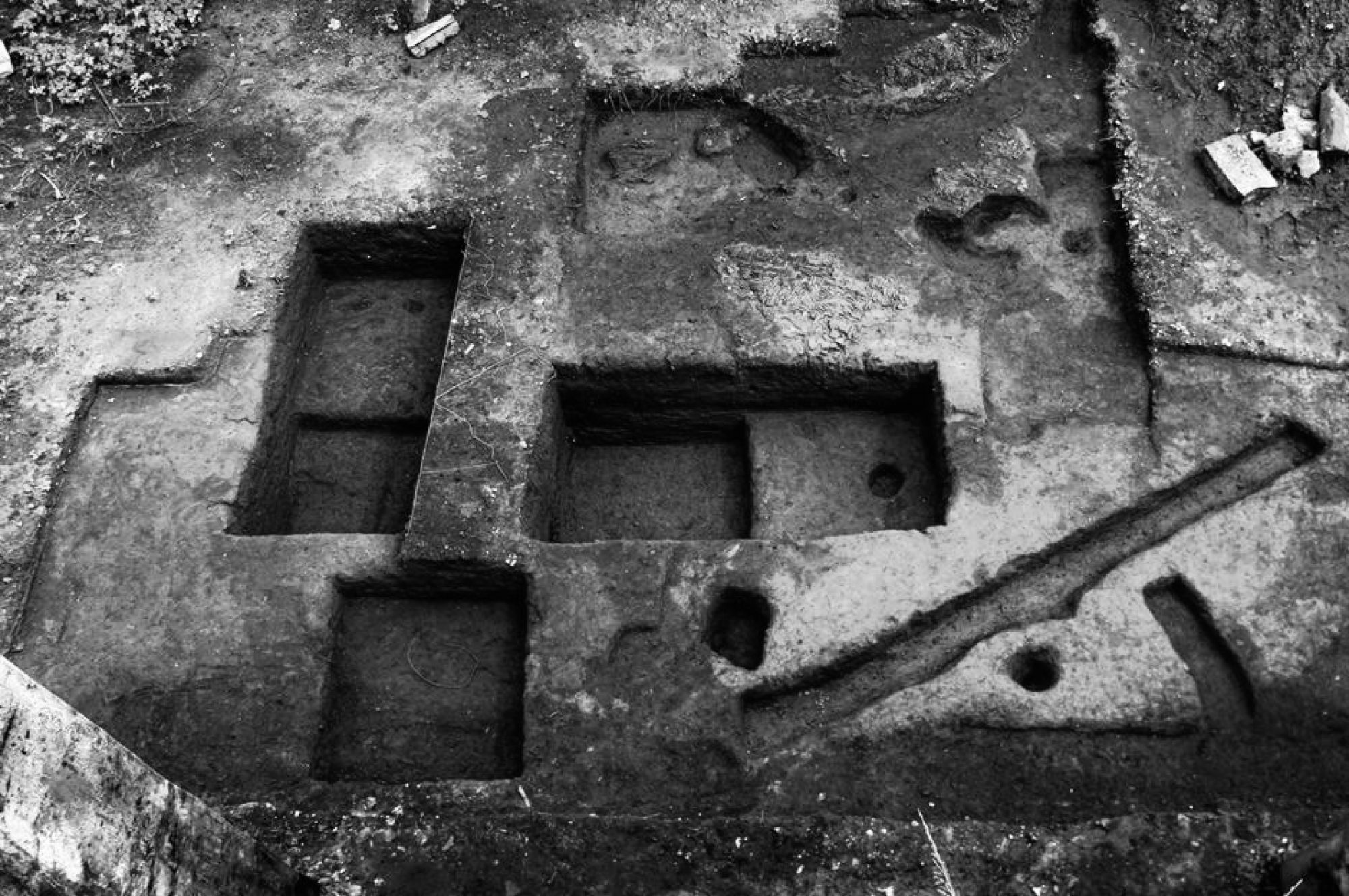
The archaeological foundation of this argument is visible in Lasisi’s 2023 Courtauld presentation on the cartosemiotic properties of Yoruba potsherd pavements. The abstract describes two examples: a carved pavement effigy associated with Ògún and the mapping of ritual movement, and a geometric pavement interpreted in relation to priestly formation and solar movement. These interpretations broaden the analysis of pavement from its material composition and domestic function to its potential role as a mnemonic and spatial instrument (Lasisi 2023a).
A related University of Virginia lecture addresses pavements in Ìjẹ̀bú and Ilé-Ifẹ̀ through indigenous hermeneutics, investigating their proposed functions in time-reckoning, cartography, art and ritual (Lasisi 2023b). In February 2026, a Stanford Archaeology Center presentation extended this argument to the relationship between embodied movement, sacred networks, celestial orientation and political authority (Lasisi 2026a). The conference and lecture abstracts document the research programme and its propositions; they should not substitute for the full archaeological datasets needed to evaluate individual alignments or interpretations.
The methodological implication is consequential. Architecture is not exhausted by walls, materials or enclosed volume. Repeated, socially authorized movements can organize a landscape even where their routes are not bounded by permanent built structures. Ritual choreography becomes an architectural relation linking bodies, places, memory and calendrical occasions. The tangible pavement and the performed route are therefore different but connected forms of evidence.
This approach draws on an understanding of Yoruba knowledge traditions as resources for theory formation, not merely as ethnographic illustrations of externally derived categories. Oral testimony, ritual practice and linguistic interpretation require contextual evaluation, just as artifacts do. Such a perspective resists both the reduction of Yoruba material culture to function alone and the assumption that every formal resemblance necessarily encodes a celestial or ritual meaning.
3. A three-register analytical method
The present study is a qualitative, comparative reading of five publicly accessible essays and the scholarly presentation abstracts identified above. It is grounded in a July 2026 research report and a subsequent reading of the original website texts. It does not claim to have completed a systematic lexical count, an archaeological reanalysis, an interview programme or an audience study.
Three registers organize the analysis. The literary register examines voice, genre, figures, chronology and metaphor. The philosophical register considers arguments about identity, temporality, knowledge and the observer’s relationship with the record. The material-historical register addresses propositions that can be evaluated against artifacts, dated documents, independent testimony or other empirical sources. A single passage may participate in all three registers, but the evidentiary requirements do not automatically transfer from one to another.
The approach engages Nancy Munn’s account of culturally constituted time (1992), Gavin Lucas’s archaeological investigations of temporal multiplicity (2005, 2022), Henri Lefebvre’s analysis of rhythms (2013), and George Lakoff and Mark Johnson’s account of metaphor as a structure of thought (2003). Michel Foucault’s archaeology of statements and Michael Shanks’s archaeological imagination provide additional points of comparison. These frameworks are interlocutors rather than substitutes for Lasisi’s indigenous epistemological commitments.
4. The Architecture of Recurrence: historical mutation and the digital web
The opening of The Architecture of Recurrence places the narrator in 2099, a future retaining recognizable features of 1999. Technological change has not eliminated older configurations of domination, public performance and social anxiety. Instead, the essay maps transformations between empire and corporation, prophecy and influence, and the public square and algorithmic platforms (Lasisi 2026c). This is not a claim that the institutions are historically identical. It is a proposition about functional continuities across altered infrastructures.
The formal argument resembles the archaeological problem of recognizing continuity through changing assemblages. One must specify the relation that persists and examine the material changes through which it is reproduced. Applied to digital environments, this requires attention to the interface, the institutions that govern visibility, the economic value of attention and the forms of identity that platforms encourage. The essay’s argument about performance is a critical hypothesis that can be investigated rather than a comprehensive empirical description of digital society.
Morpheus and Spider embody another scale of recurrence. Morpheus is the childhood observer; Spider is the adult whose nickname, the narrator explains, dates to 2007 and arose from dexterity with numbers, computers and the web. The two figures dramatize continuity between early experiences and later analytical practices. Yet the web is ambivalent: it enables connections while also constraining its maker. The essay’s movement from pattern recognition to its possible excess introduces a necessary methodological question: how does a researcher distinguish an informative recurrence from a pattern produced by the act of interpretation itself?
The face-me-I-face-you compound offers an especially productive answer. The narrative returns from abstract theory to corridors, households, greetings, shared food, economic necessity and maternal work. Architecture here is a lived network of proximity and obligation. The landlord’s questions about fatherhood and the key become a mnemonic event whose later meanings exceed its original circumstances. The text does not establish a universal symbolic equivalence between father and key; it demonstrates how an autobiographical narrator constructs that association and carries it forward.
5. The Inferno Could Not Recognize Me: embodiment, rupture and memory
The Inferno Could Not Recognize Me juxtaposes the millennium transition with remembered childhood dangers. Y2K functions as a narrative threshold between a materially grounded world and a culture increasingly organized through screens, signals and distributed representations. In the narrator’s account, the hospital fire and an electrical transformer explosion also become thresholds, linking experiences of danger and maternal protection to subsequent reflections on survival, identity and time (Lasisi 2026b).
The essay recounts extraordinary experiences and advances metaphysical propositions about the body and consciousness. These passages are analyzed as authorial testimony and philosophical speculation, not independent confirmation of physical invulnerability, temporal displacement or survival beyond ordinary causality. This distinction permits close engagement with the narrative while retaining the methodological discipline of archaeology.
Its distinctive contribution is to represent memory as unevenly durable. The intensity of certain childhood images contrasts with the narrator’s account of earlier gaps surrounding his father’s death. The interpretive significance of an absence is not equivalent to evidence of its cause. Nonetheless, the absence itself shapes the work: missing memories become the impetus for reconstructing the self, much as an incomplete archaeological record motivates inquiry into relationships no longer directly observable.
The candle-wax motif gives this problem a material form. Wax remaining after a flame has gone is presented as a trace of illumination. Read archaeologically, it invites a distinction between the surviving residue, the process that produced it and the meanings subsequently attributed to it. The narrator’s conceptual movement from substance to memory illustrates how material images become instruments of philosophical thought.
6. Àárín Òsà: the vessel as a relational architecture
In Àárín Òsà: Where Masters Fell, three master sailors, Adígún, Òsìfèkúndé and Àkànmú, admit the fearful Pẹ́térù into their canoe. Their coordinated confidence deteriorates and the vessel capsizes. The parable places mastery not exclusively within the individual but within a shared arrangement of bodies, rhythms, expectations and environmental conditions (Lasisi 2026d).
The movement from Etí-Òsà, the shore, to Àárín Òsà, the middle of the water, organizes the narrative spatially. Departure removes the stable horizon of land; the canoe becomes the immediate architecture within which collective action must be sustained. Its fate dramatizes a failure of coordination. Fear is the explanatory language of the parable, not a demonstrated physical law of navigation.
This miniature architecture offers a comparison with ritual movement. In both cases the coherence of a practice depends upon relationships among participants, rather than individual skill alone. The ethical implications are open to debate: the narrative emphasizes guarding the collective vessel, while a complementary inquiry might ask how training, mutual care and institutional design can support vulnerable participants. Such a reading preserves the parable’s tension between responsibility to the collective and responsibility to the person.
7. The Genesis Anomaly: language as archaeological evidence
The Genesis Anomaly begins with the author’s recollection of a difference between the singular and plural rendering of heaven in Genesis 1:1. It then develops into a meditation on the relationship between an earlier reading, a later encounter with a text and the interpretive world formed between them. Significantly, the author explicitly considers whether the change lies in the relationship between observer and record rather than in the physical text itself (Lasisi 2026e).
This is a productive site for linguistic archaeology. A word becomes a small but consequential material and semantic trace, capable of organizing a much larger conceptual structure. The distinction between singularity and multiplicity prompts questions about the unity of truth and the partial character of culturally mediated understanding. These philosophical questions do not depend on proving an extraordinary alteration of scripture.
A textual-historical study would require dated editions, photographs or facsimiles, bibliographic identifiers and a comparison of Hebrew and English translation traditions. Until that comparison is undertaken, the remembered reading and the currently observed reading must be preserved as distinct records. The methodological point is broader: anomalies are opportunities for investigation, but observation, provenance and explanatory hypothesis must remain distinguishable.
8. The Vanguard of the Key: transmission and the cost of continuity
The Vanguard of the Key provides the most explicit statement of the memoir’s genre and conceptual organization. Morpheus preserves the rejected fragments of physical and relational history, including the compound and the landlord’s words, and passes the Key to Spider. Spider is then charged with protecting continuity within the digital environment (Lasisi 2026f). The Key is an assemblage of names, memories and obligations rather than simply a device for unlocking a place.
The Vanished, the Vanquished and the Vanguard acquire specific positions in this text. The Vanished threaten to squander the Key’s grounding capacity; the Vanquished threaten to weaponize it; the Vanguard bears responsibility for preservation and transmission. These are narrative categories with ethical functions, not labels to be applied indiscriminately to actual people. The paradox of the Key is that transfer threatens the very memory it seeks to preserve.
The author describes the memoir as “fictional non-fiction and non-fictional fiction.” The formulation is central to this paper because it identifies genre mixture as a deliberate component of the work. The memoir can operate simultaneously as autobiographical recollection, philosophical experiment and a narrative manual of continuity without the epistemic status of these registers becoming identical.
The relationship with archaeology is particularly clear here. Heritage does not persist through storage alone: it requires successive acts of interpretation and transmission. A material object may survive while knowledge of its use disappears. Conversely, a practice may endure even when its original materials have been replaced. The Key dramatizes this tension between the durability of a carrier and the vulnerability of the knowledge entrusted to it.
9. Toward a critical archaeology of recurrence
The five essays permit a provisional model organized around five operations: trace, relation, repetition, transformation and transmission. A trace is a surviving or recorded element; a relation specifies the arrangement through which it acquires meaning; repetition establishes a possible correspondence across occurrences; transformation describes the contextual differences; and transmission concerns the means by which a relation is carried into another setting.
The model is applicable across the domains considered in this article. A pavement can preserve a spatial arrangement associated with ritual movement. A calendrical occasion can coordinate renewed collective action. A remembered phrase can reappear in autobiographical interpretation. A digital platform can reproduce an older relationship of authority in a different technological form. In each instance, an analysis must identify the proposed continuity as well as the discontinuities, and consider alternative explanations.
Three research propositions follow. First, a systematic comparison of Lasisi’s archaeological and literary corpora should reveal whether a stable relational vocabulary persists across genres. A reproducible coding scheme could distinguish architectural, mnemonic, temporal and cartographic concepts and record both their frequency and their contextual function. Second, the contribution of digital media to the reception of the memoir could be tested by comparing readers’ responses to the same material with and without its embedded audiovisual paratexts. Third, archaeological investigations of ritual movement could distinguish durable spatial traces from reconstructed routes, using independent oral histories, spatial recording and historical sources to evaluate proposed correspondences. These are proposed research designs, not results already established by this article.
The framework has particular relevance to African archaeological theory because it begins with a scholarly programme already concerned with indigenous practices of knowing. It also offers a way to approach public intellectual production without treating poetic experimentation as a deficiency or mistaking it for empirical demonstration. The critical dimension lies in making the conditions of an interpretation visible: who observes, what survives, how a relation is inferred and what would count against it.
10. Conclusion
Lasisi’s May 2026 prose cycle is best understood in conversation with his archaeological work rather than in isolation from it. Across the five texts, a conceptual migration occurs from pavement to page, from ritual movement to autobiographical becoming, from the mapped landscape to the digital network, and from material residue to the archive of memory. The result is an inquiry into the conditions under which identity, knowledge and social structures endure through transformation.
A critical archaeology of recurrence does not demand that the past return unchanged. Its task is to recognize the relations that recur, account for the contexts that transform them and investigate the means by which they are transmitted. Its particular contribution is to hold together material inquiry, indigenous hermeneutics and the archaeological imagination without collapsing their different evidentiary responsibilities.
The work of the archaeologist, in this formulation, is not only to recover traces of an earlier world. It is also to ask what those traces make possible for a world still being formed.
References and primary sources
Lasisi, Olanrewaju. 2023a. “On the Architecture of Ritual Movements and the Cartosemiotic Properties of Yoruba Potsherd Pavement.” The Courtauld, Art and Architecture of Mapping, conference abstract.
Lasisi, Olanrewaju. 2023b. “An Indigenous Hermeneutic Approach to the Archaeology of Potsherd Pavements in Yoruba Culture.” University of Virginia, October 20.
Lasisi, Olanrewaju. 2026a. “Architecture of Ritual Movement: Indigenous Epistemologies, Archaeoastronomy, and the Making of Yoruba Sacred Landscapes.” Stanford Archaeology Center, February 11.
Lasisi, Olanrewaju. 2026b. “The Inferno Could Not Recognize Me.” Quantum X Archaeology, May 11.
Lasisi, Olanrewaju. 2026c. “The Architecture of Recurrence.” Quantum X Archaeology, May 15.
Lasisi, Olanrewaju. 2026d. “Àárín Òsà: Where Masters Fell.” Quantum X Archaeology, May 21.
Lasisi, Olanrewaju. 2026e. “The Genesis Anomaly: The Fluidity of Text and the Architecture of Sameness.” Quantum X Archaeology, May 21.
Lasisi, Olanrewaju. 2026f. “VII. The Vanguard of the Key.” Quantum X Archaeology, May 22.
Foucault, Michel. 1972. The Archaeology of Knowledge. Translated by A. M. Sheridan Smith. Pantheon Books. Originally published in French in 1969.
Lakoff, George, and Mark Johnson. 2003. Metaphors We Live By. University of Chicago Press.
Lefebvre, Henri. 2013. Rhythmanalysis: Space, Time and Everyday Life. Bloomsbury.
Lucas, Gavin. 2005. The Archaeology of Time. Routledge.
Lucas, Gavin. 2022. Making Time: The Archaeology of Time Revisited. Routledge.
Munn, Nancy D. 1992. “The Cultural Anthropology of Time: A Critical Essay.” Annual Review of Anthropology 21: 93–123.
Shanks, Michael. 2012. The Archaeological Imagination. Routledge.
Publication and provenance note
Olanrewaju Blessing Lasisi — original concept and source writings; AI-assisted development/presentation. This working paper was developed from the July 2026 research report Toward a Critical Archaeology of Recurrence in the Writings of Olanrewaju Lasisi and the five original public essays. The current version is an interpretive study, not a peer-reviewed journal publication. It does not analyze the full unpublished memoir, reproduce the archaeological field datasets, or transcribe embedded audiovisual material. Secondary bibliography is retained from the research framework, with standard publication details; a journal submission would require final bibliographic and edition checks.

