
The Architecture of the Secret
Humanity’s migration into the year 2000 was driven by a desperate, unspoken wish. The creation of the World Wide Web and the frenzied adoption of the digital realm were never merely engineering marvels; they were acts of global evacuation. Humanity was attempting to let go of its baggage. The old physical world was heavy with history, trauma, decay, and consequence. The emerging digital frontier offered an intoxicating, almost religious illusion: a space without gravity, a blank slate where the soul could exist as pure, unburdened signal. But in their rush to abandon the physical, civilization forgot that a tether must remain. Without an anchor, the mind does not transcend; it merely vanishes into the noise.
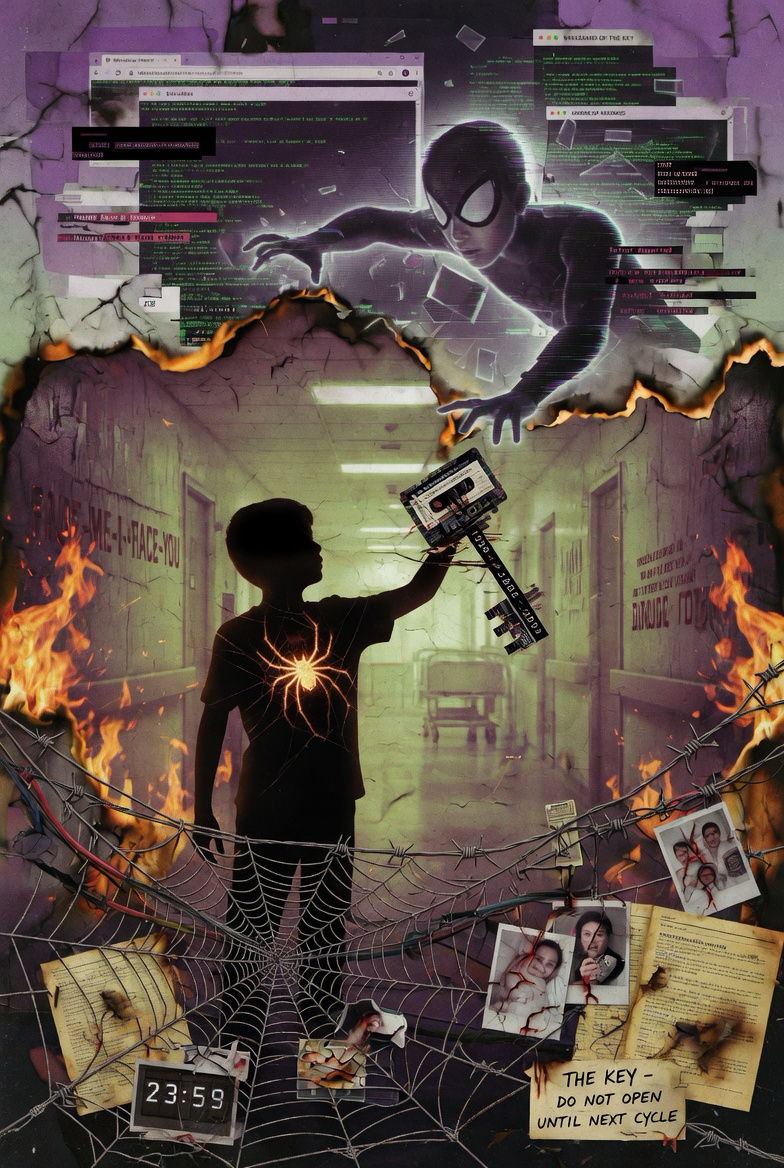
Morpheus understood this. The boy who had walked through the hospital inferno and watched reality detonate beneath the transformer knew that someone had to stay behind to hold the weight. He became the Vanguard for the Spider. While the rest of the world rushed eagerly into the void of the new millennium, abandoning their metaphysical density for the convenience of algorithms, Morpheus remained anchored. He gathered the rejected fragments of physical certainty—the memories, the names, the visceral truth of the face-me-I-face-you compound, the terrifying clarity of the landlord’s voice—and forged them into the Key.
The Spider of the future—the entity observing the systemic collapse from the vantage points of 2026 and 2099—was never a lost soul drifting in the digital void. He is the architect. He is the living fuel of a new world built from the ashes of the old. But an architect cannot sustain a structure without a foundation. When the recursion of time completes its cycle, a profound and necessary switch occurs: Morpheus hands the Key to the Spider.
In receiving this Key, the Spider assumes his ultimate role. He does not just navigate the web; he becomes the Vanguard of the web space itself. He stands at the digital gates to protect the next Spider—the next architect of consciousness—from the very vanishing that threatens to consume anyone who dares to study the abstract depths of the matrix. The world entering 2000 sought to escape its history, but the Spider holds the history so the future does not collapse.
This realization transforms the very nature of these writings. I understood then that this Memoir of Madness is not merely a record of past events or a static autobiography. It is a unified work of fictional non-fiction and non-fictional fiction, because truth operating at this frequency cannot survive naked; it must be clothed in paradox to bypass the defenses of ordinary logic. These words are a secret pamphlet. They are a survival manual encoded for future generations, designed to help them navigate the variegated media spaces of their own eras. It is a blueprint for understanding the fluidity of time, the architecture of upbringing, and the solitary, often agonizing personal quest for knowledge in a world that constantly demands performance over presence.
But possessing the Key is a terrifying burden. To what extent can the Spider conceal it? He must hide it from the Vanished, who would blindly squander its grounding power, and from the Vanquished, who would attempt to autocratically weaponize it. Most dangerously, he must hide it from himself, burying it deep within the architecture of this very memoir, waiting patiently until the perfect entity—the rightful, stabilized inheritor of the consciousness—is ready to decipher the code.
This hesitation to fully reveal the Key is born of pure survival. The Spider is acutely weary of the cost of transfer. Every time a Key changes hands across the temporal loop, a severe toll is exacted on the mind. The ultimate repercussion of transferring the Key is the redaction of history itself: memory loss. To pass the Key is to risk forgetting why it was held in the first place. It is to risk returning to the blank, redacted slate of a nine-year-old boy standing in a crowded corridor, waiting for a father who has already departed.
And so, the Spider spins his web in the liminal spaces between 1999, 2026, and 2099. He holds the center and guards the threshold. He bears the immense weight of the past to sustain the fragile architecture of the future, waiting for the precise moment in the timing of time to safely surrender the burden, embrace the erasure, and allow the next cycle of existence to begin.
MORPHEUS LEE

