

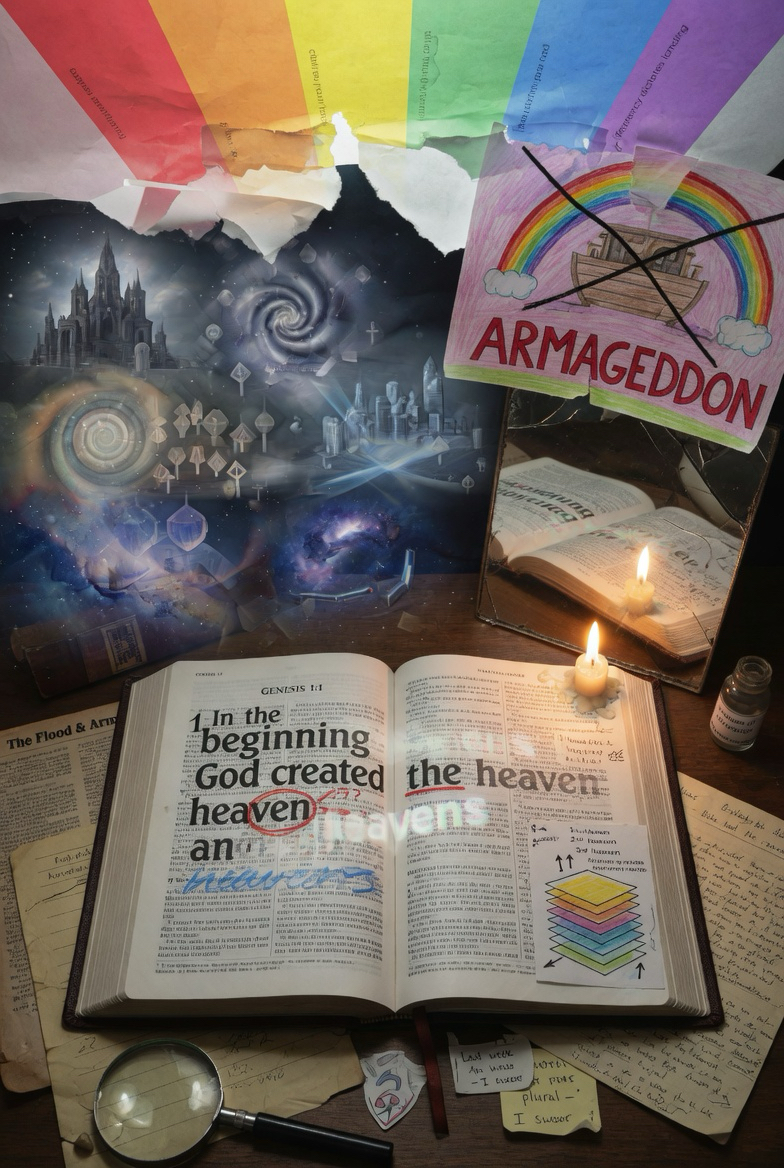
Look at your Bible. Open it to Genesis 1:1. Do not skim it. Actually look at it, because a single word is enough to fracture an entire world.
For those who treat language as the literal fabric of reality, a word is not small. It is structural. It defines the shape of understanding itself. Last week, I read the King James Version, a hard copy text I know with absolute clarity. The scripture read, “In the beginning God created the heavens and the earth.” Today, I open the same KJV translation, and the architecture of the verse has shifted. The plural is gone. It now reads, “In the beginning God created the heaven and the earth.”
Mainstream scholars will immediately try to intellectualize this away. They will point to the Hebrew word Shamayim, debate formal versus dynamic translation philosophies, or attribute the difference to publisher variations. When those explanations fail to satisfy, the conclusion becomes predictable: memory is flawed, perception is unreliable, and what is being observed is dismissed as error. Hyper-awareness is pathologized because the alternative is uncomfortable. It requires entertaining the possibility that something more subtle is taking place.
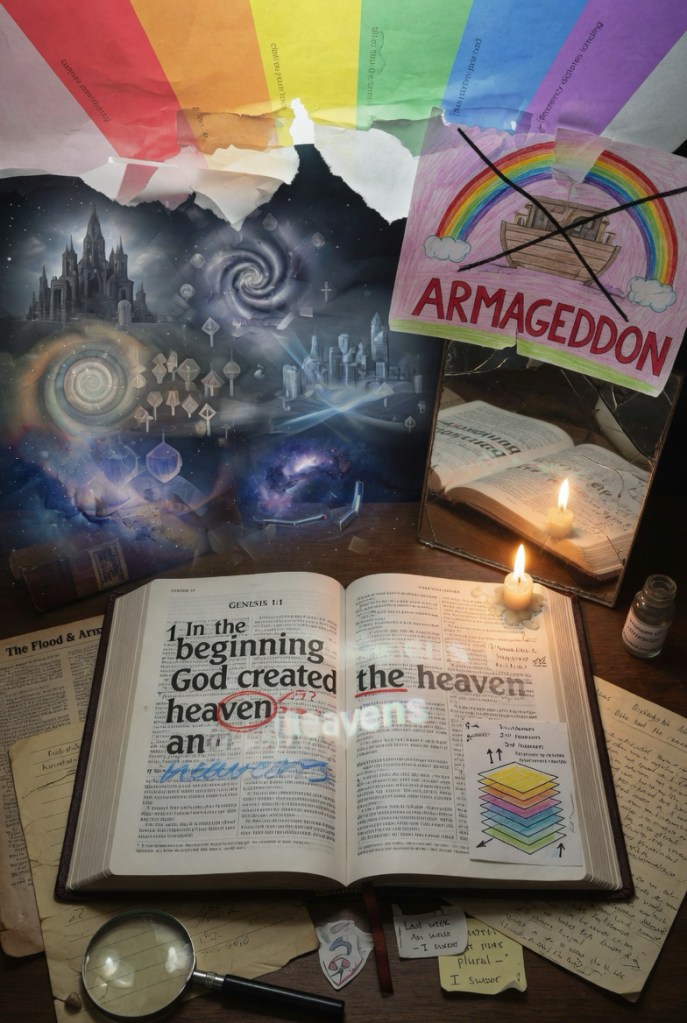
This is not my first encounter with that kind of fracture. As a child, I read My Book of Bible Stories, and that version left a deep structural imprint on how I understood the narrative arc of the world. The copy I hold now is not an old, worn artifact shaped by time. It is a brand-new version I purchased as an adult, expecting alignment with what I carried forward. Instead, what I encountered was not deterioration, but contradiction.
In my memory, the story moved toward apocalyptic finality. Fire and flood were not isolated events; they were signals of an inevitable reckoning. The narrative carried urgency and weight, a sense that everything was building toward collapse and judgment. That structure felt fixed, anchored, unmistakable. But the version I hold now does not resolve that way. The catastrophe has softened. The finality has dissolved. What once felt like an unavoidable end now settles into something quieter, something closer to restoration than destruction.
So the question is unavoidable. What changed? Was it the text, or was it the structure I built from it as a child?
This is not simply about remembering a word incorrectly. It is about carrying an entire atmosphere, an interpretation so complete that it becomes indistinguishable from the source itself. When that atmosphere no longer matches what is on the page, it does not feel like a mistake. It feels like encountering a different ending altogether.
What does it mean when something feels removed not through erosion, but through absence? We often say time moves forward, but if it truly does, does it leave the past untouched behind us? Or does movement itself reshape how the past is structured, remembered, and even encountered?
Perhaps nothing changed in the crude, provable sense. Perhaps what shifted is more subtle. Not a rewritten page, but a changing relationship between observer and record. Not a different text, but a different alignment between what is seen and what is known. Or perhaps the past has never been as fixed as we assume. Perhaps it is not a static archive, but something we continually meet from a moving position, something that appears stable only because we rarely notice the movement itself.
Even that may not be the center of the issue. Set aside the shock and the need to prove anything. Look instead at what the difference implies.
One heaven is contained and singular. Heavens are layered and open-ended. If the text reads as “heavens,” it invites multiplicity. It allows for competing interpretations, multiple destinations, and parallel frameworks to coexist without resolving their contradictions. But that interpretation introduces its own tension. If there is one source behind all things, that source does not multiply because language does. It does not fracture because understanding fractures. It does not become many simply because we cannot agree.
This leads directly into a deeper paradox. If the one you call the mighty God is not the one I call the mighty God, then either there is no such God, or neither of us knows that God as we claim. The same tension applies to heaven. If it is real and absolute, it should not differ from person to person. It should not shift between singular and plural, between one version and another. And if it does, then either heaven is not what we think it is, or our certainty about it cannot hold.
So the real question is not whether there are multiple heavens or multiple Gods. It is whether what appears as multiple is actually a fragmented perception of something singular.
Truth, if it is real, does not divide. But certainty does. What we call God or heaven may not be multiple realities, but a single reality refracted through culture, language, memory, and experience until it appears as many. Not many truths, but one truth, unevenly seen, unevenly named, and repeatedly defended as complete when it is only partial.
There is a quiet arrogance in certainty. It takes what is partial and declares it whole. It takes what is translated and calls it final. It takes what is remembered and treats it as absolute.
Experiencing states of intense psychological depth does not erase a person’s capacity for observation. If anything, it sharpens it. It strips away assumptions and exposes inconsistencies. It creates a mind that notices when something no longer aligns, when the baseline of the recorded world feels unstable.
In those moments, the easiest path is self-doubt. The more difficult path is to remain grounded, to name what is observed, and to document the anomaly without immediately collapsing it into explanation.
Because if those who notice these fractures remain silent, the narrative remains unchallenged.
Go back. Open Genesis 1:1. Read what is there. Then sit with what you know was there. Do not rush to resolve the difference. Somewhere between the word on the page and the word in your mind is the space where your understanding of reality was formed.
And if there is only one God, then whatever is true has never been divided. Only described that way.
OLA LASISI

